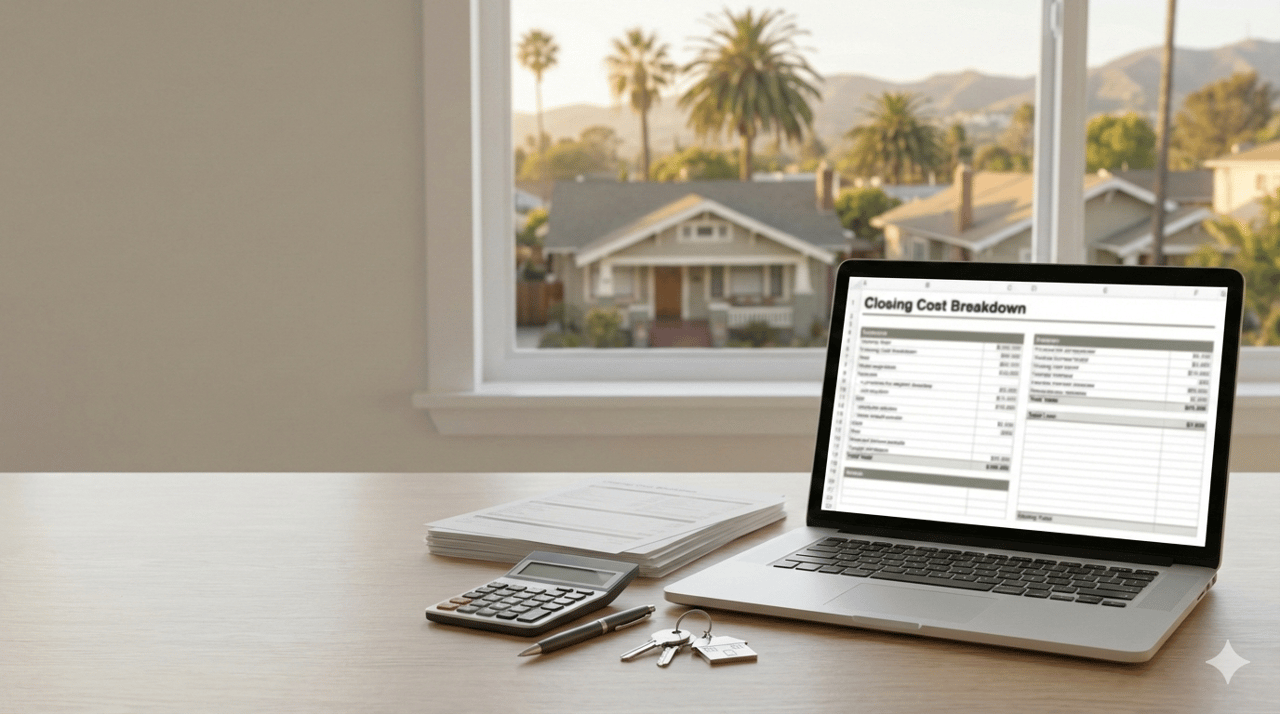
“How much do I need for closing costs?”
This is one of the most common and most confusing questions I get from buyers in Riverside and the Inland Empire.
Here’s the challenge. Closing costs aren’t a single fixed number. They vary based on your purchase price, loan type, lender, title company, and the specific details of your transaction.
What I can do is give you a clear breakdown of what closing costs typically include, realistic ranges for Riverside County, and strategies to reduce them when possible.
Let’s clear up the confusion once and for all.
What Are Closing Costs?
Closing costs are the fees required to finalize your real estate transaction and transfer ownership from seller to buyer.
They are separate from your down payment and are typically paid at the closing table, although some costs can be rolled into your loan or covered by the seller through negotiation.
In Riverside County, buyer closing costs typically range from two to five percent of the purchase price.
For example, a $400,000 home usually comes with $8,000 to $20,000 in closing costs. A $500,000 home typically ranges from $10,000 to $25,000. A $600,000 home often falls between $12,000 and $30,000.
Now let’s break down what’s actually included in that number.
Lender Fees (Loan-Related Costs)
These are fees charged by your mortgage lender to process and underwrite your loan.
The loan origination fee is typically between half a percent and one percent of the loan amount. On a $450,000 loan, that’s roughly $2,250 to $4,500. Some lenders advertise no origination fee but build the cost into a slightly higher interest rate.
Application and processing fees usually range from $300 to $900 and cover administrative work related to your loan.
The underwriting fee typically runs between $400 and $800 and covers the lender’s review and approval of your loan.
Credit report fees are usually $25 to $50 and cover pulling your credit from all three bureaus.
Flood certification costs about $15 to $25 and determines whether the property is located in a flood zone.
Tax service fees typically range from $50 to $100 and pay for monitoring property tax payments.
Some loans also include upfront mortgage insurance. FHA loans require an upfront mortgage insurance premium of 1.75 percent of the loan amount, which can often be rolled into the loan. VA loans include a funding fee that ranges from zero to 3.6 percent depending on service and down payment. Conventional loans with PMI do not have an upfront fee but include a monthly cost.
Total lender fees typically range from $3,000 to $6,000 or more depending on the loan amount and structure.
Third-Party Fees (Services Outside the Lender)
The home appraisal is required by your lender to confirm the home’s value. In Riverside County, appraisals typically range from $500 to $800 depending on the property.
A home inspection is not technically a lender-required closing cost, but it should always be done. In Riverside, inspections usually cost between $400 and $600 for a standard home.
Depending on the property, you may also need additional inspections such as termite or pest inspections, sewer line inspections, roof inspections, chimney inspections, or pool inspections.
Title search and examination fees generally range from $150 to $400 and cover researching the property’s ownership history.
Title insurance protects both you and your lender against ownership issues. The lender’s title policy is required and typically costs between $1,200 and $2,000 on a $450,000 loan in Riverside County. The owner’s title policy is optional but recommended and is often a similar cost. In some Riverside transactions, the seller traditionally pays for the owner’s policy, but this is negotiable.
Escrow fees vary by purchase price and are often split between buyer and seller. The buyer’s portion is typically $800 to $2,000.
Recording fees charged by Riverside County generally range from $50 to $250. Notary fees usually fall between $50 and $200. Settlement or closing fees charged by the escrow or title company typically range from $300 to $500.
If the property is part of an HOA, there may be transfer or documentation fees ranging from $200 to $500.
Total third-party fees usually fall between $3,000 and $6,000.
Prepaid Items and Escrow Impounds
These are not exactly fees, but they are funds you’ll need at closing.
Homeowners insurance is typically paid for the first year at closing. In Riverside County, premiums usually range from $800 to $2,000 or more per year depending on coverage and property type.
Property taxes are prorated based on your closing date. In Riverside County, property taxes are approximately 1.1 to 1.3 percent of assessed value. On a $500,000 home, that’s roughly $5,500 to $6,500 per year.
If you close mid-year, you may prepay several months of taxes at closing.
If the home is in an HOA, you may need to prepay dues through the end of the month or quarter.
Prepaid mortgage interest is collected from your closing date through the end of the month. For example, closing on June 15 on a $450,000 loan at seven percent would result in roughly $1,970 in prepaid interest.
Some lenders also require funding an escrow impound account with two to three months of property taxes and insurance upfront.
Total prepaid items often range from $2,000 to $6,000 or more.
A Real Riverside Example
Let’s look at a typical Riverside purchase.
On a $500,000 home with a ten percent down payment and a $450,000 loan at seven percent interest, lender fees might total about $4,610. Third-party fees could come in around $4,925. Prepaid items might total approximately $5,695.
That puts total closing costs at roughly $15,230, which is about 3.05 percent of the purchase price.
How Closing Costs Vary by Loan Type
Conventional loans typically have closing costs between two and five percent of the purchase price and include PMI only if less than twenty percent is put down.
FHA loans require a three and a half percent down payment, include upfront and annual mortgage insurance, and usually have slightly higher total closing costs.
VA loans require no down payment, have no monthly mortgage insurance, and include a funding fee depending on eligibility and usage.
USDA loans also require no down payment but include upfront and annual guarantee fees.
Strategies to Reduce Closing Costs
You can shop for certain services such as homeowners insurance, title insurance, and home inspections. You cannot shop for items like the appraisal, credit report, or recording fees.
Seller concessions can also reduce your out-of-pocket costs. In many Riverside transactions, especially in slower markets, sellers may agree to contribute toward buyer closing costs.
Some lenders offer credits toward closing costs in exchange for a slightly higher interest rate. This can make sense if you plan to refinance or need to preserve cash.
Closing near the end of the month can reduce prepaid interest, which lowers the cash required at closing.
Comparing Loan Estimates from multiple lenders is one of the most effective ways to save money. Lender fees can vary by thousands of dollars for the same loan.
Common Closing Cost Mistakes
A common mistake is not budgeting enough and forgetting to account for closing costs on top of the down payment.
Another mistake is not reviewing the Loan Estimate carefully and discovering unexpected fees at the last minute.
Some buyers also believe no-closing-cost loans are free, when in reality the costs are simply structured differently.
Finally, many buyers forget to ask about seller concessions when they may be available.
Your Closing Disclosure
Three days before closing, you’ll receive a Closing Disclosure with the final breakdown of all costs.
Review it carefully and compare it to your Loan Estimate. If anything looks off, ask questions immediately. You have the right to understand every fee.
The Bottom Line
Plan for two to five percent of the purchase price in closing costs.
On a $500,000 home in Riverside, that usually means budgeting between $10,000 and $25,000 depending on your loan and situation.
The good news is that many of these costs can be negotiated, reduced, or planned for with the right strategy.
Ready to Get Accurate Numbers?
If you want to know exactly what your closing costs will look like for your specific purchase in Riverside or the Inland Empire, let’s walk through it together.
We’ll review your Loan Estimate, identify opportunities to save, and build a complete budget that includes down payment, closing costs, and a post-closing cushion.
Contact me today and I’ll help you understand every line item with confidence.