Mortgage Rates Are Back Over 7%: What Could Happen to the Riverside Housing Market?
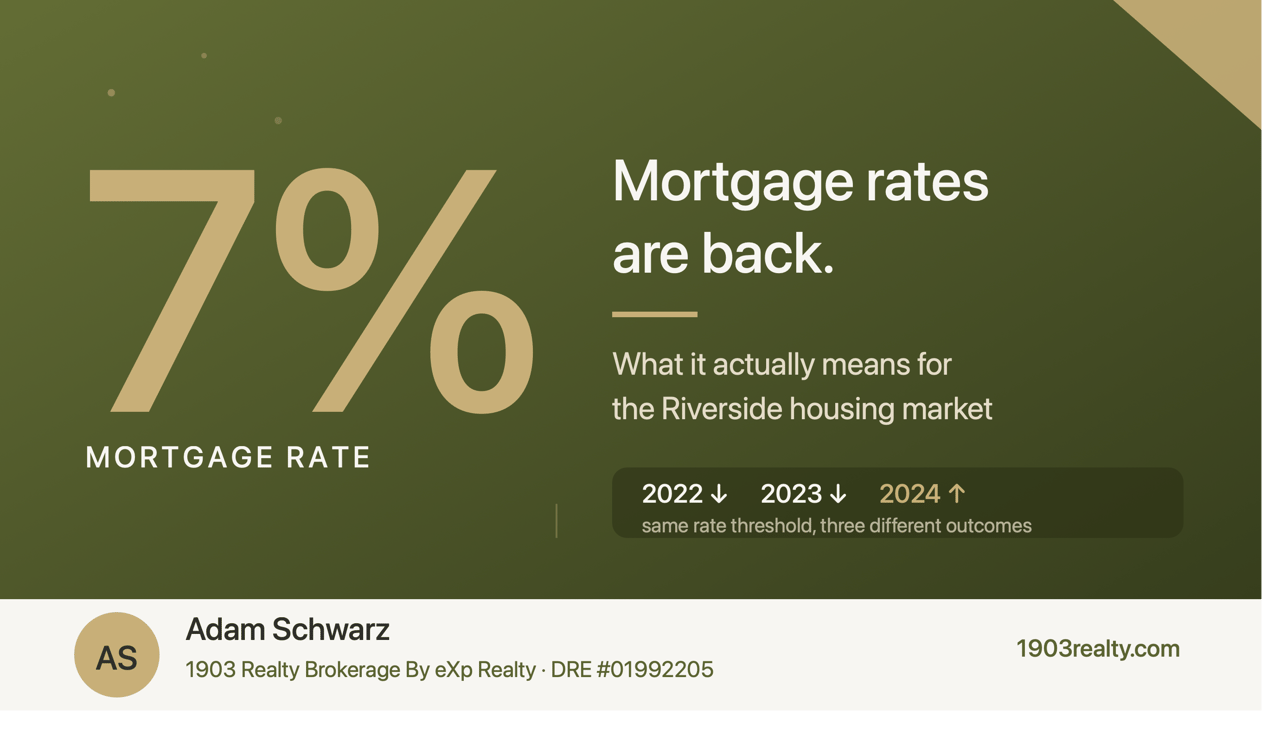
Does a 7% mortgage rate mean falling home prices in Riverside, CA? Not based on the last three times it happened. In 2022 and 2023, closed sales dropped sharply while prices held. In 2024, rates crossed 7% again and prices actually went up. Rate level alone doesn't decide where the market goes.
Every time mortgage rates climb, the same questions start showing up in my inbox: Are prices about to fall? Are buyers about to disappear? Is this the crash people keep predicting?
Instead of guessing, I went back and looked at what actually happened in Riverside the last three times mortgage rates crossed 7%. The pattern isn't what most people assume.
I break down all the numbers in this video: Watch the full breakdown
What Happened in Riverside Each Time Rates Hit 7%
Year | What rates did | What happened to closed sales | What happened to prices |
|---|---|---|---|
2022 | Jumped from ~3% to over 7% | Fell from ~265 sales (Sept.) to ~160 (Feb.) | Softened, but had already started slowing before rates crossed 7% |
2023 | Climbed toward 8% | Fell from ~220 sales (Aug.) to ~161 | Held relatively stable |
2024 | Crossed 7% again | Increased | Increased |
Three different years, three different outcomes at the same rate level. That's the first sign that 7% isn't a magic number that breaks the market on its own.
2022: The First Rate Shock
At the start of 2022, mortgage rates were still around 3%. By fall, they'd crossed 7% — a massive move in a short window. A buyer who'd been shopping at one monthly payment suddenly found the same house cost dramatically more, with no change in price.
That was an affordability shock, and it showed up almost entirely in transaction volume. Riverside went from roughly 265 closed sales in September 2022 to around 160 by February 2023. Prices softened, but the slowdown in price growth had actually started before rates crossed 7% — the rate spike hit sales volume harder than it hit values.
2023: Rates Neared 8%
Rates crossed 7% again in 2023 and eventually pushed close to 8%. You'd expect that to be the moment prices finally cracked. It wasn't.
Prices stayed relatively stable while sales kept sliding — from around 220 closed sales in August 2023 to roughly 161. Once again, higher rates hit how many homes sold, not what they sold for.
Something else was happening too: buyers were adjusting. Going from a 3% world to a 7% world was a shock. Going from 6.5% to 7% barely registered by comparison.
2024: The Story Changed Again
Then rates crossed 7% a third time in 2024 — and this time, Riverside home prices increased and more homes sold. Same rate threshold, opposite result.
That's the point: mortgage rates are one input, not the whole equation. Inventory, buyer demand, employment, affordability, and seller motivation all move the needle too. And over time, people adjust to whatever "normal" looks like.
What 7% Actually Changes
I don't think 7% is a number where the housing market stops working. I think it's a number where buyer behavior changes.
When payments get more expensive, buyers get more selective. In a fast market, a buyer might overlook a dated kitchen or worn flooring because everyone's competing for the same houses. In a slower market, they're doing the math on every listing: Is this house really worth this monthly payment?
That shift is exactly what sellers need to plan around right now.
If You're Selling: Condition, Price, and Value Matter More
If your home was already sitting on the market at 6.5%, moving to 7% doesn't make it easier to sell — the buyer's payment just got bigger. That puts the pressure on three things:
- Condition — homes that show well still attract buyers
- Price — accuracy matters more than optimism
- Value — buyers are comparing payment-to-value, not just list price
The days of pricing aggressively and assuming someone will meet you there are largely gone in a slower rate environment. Sellers should also be thinking beyond price: closing-cost credits or helping a buyer buy down their rate can sometimes move a deal further than a small price cut ever would.
Why Some Riverside Sellers Are Choosing to Stay Put
There's a piece of this market that doesn't get talked about enough: a lot of homeowners simply don't have to sell.
I recently worked with sellers who wanted a downstairs bedroom for a family member who visits a few times a year. They have a low rate on their current home. Once rates moved above 7%, the replacement home they wanted would have nearly doubled their monthly payment. The downstairs bedroom wasn't worth that — so they stayed put.
That decision is playing out across Riverside and the Inland Empire. When homeowners have equity and a low fixed payment, many of them can simply opt out of the market rather than trade up at today's rates. That's part of why inventory stays tighter than you'd expect in a higher-rate environment.
Buyers: Higher Rates Can Mean More Leverage
Higher rates aren't good news for a buyer's monthly payment — that part's obvious. But there's a trade-off: less competition.
Sellers are often more willing to negotiate. Homes sitting for 30, 45, or 60-plus days can open up options that simply weren't on the table during the fastest-moving years. Instead of focusing only on the asking price, buyers in this market should be asking:
- Could I negotiate a seller credit?
- Could the seller help buy down my rate?
- Could I negotiate repairs?
- Are there better terms available than the list price suggests?
A higher-rate market doesn't mean you shouldn't buy. It means you need a sharper strategy than "make an offer and hope."
What I'm Watching Next in Riverside
Over the next 60 to 90 days, I'm tracking two numbers closely: home prices and closed sales.
If rates stay above 7%, expect fewer transactions and more price reductions from sellers who genuinely need to move. At the same time, sellers who don't need to sell may pull their homes off the market rather than accept a lower number. That push-and-pull is exactly why "rates are at 7%, so prices are falling" is too simple a take for this market.
The numbers don't lie, but they also don't tell the whole story on their own — real estate is local, and Riverside has shown three different outcomes at the same rate level in three years.
FAQ: Mortgage Rates and the Riverside Housing Market
Does a 7% mortgage rate always cause home prices to drop? No. In Riverside, rates crossed 7% in 2022, 2023, and 2024 with three different results — prices softened once, held stable once, and increased once. Rate level alone doesn't determine price direction.
What does a 7% mortgage rate change if not prices? Mostly transaction volume and buyer behavior. Closed sales dropped sharply in 2022 and 2023 as rates rose, and buyers became more selective about condition and value rather than competing on every listing.
Should I sell my Riverside home now or wait for rates to drop? It depends on your specific situation — your current rate, your equity, and what you're moving into. Here's what that means for you: the answer is rarely the same for every homeowner, which is why it's worth talking through your numbers directly.
If you're thinking about buying or selling in Riverside or the surrounding Inland Empire, let's look at what the market is doing in your specific neighborhood. Call or text me at 951.540.0498, email [email protected], or visit 1903realty.com.
Watch the full video breakdown: https://youtu.be/7DRLT0_ter0
Adam Schwarz REALTOR® | DRE #01992205 1903 Realty Brokerage By eXp Realty 951.540.0498 | 1903realty.com | @Adam.schwarz.realtor