Selling a House in a Down Market in Riverside
What does selling a house in a down market in Riverside actually mean for sellers in 2026?
Riverside's housing market in 2026 has cooled from its peak years, with homes averaging roughly 60–70 days on market, listing prices dipping modestly year-over-year, and buyers negotiating harder on price, repairs, and terms. It's not a collapse, closed prices are still holding near $630,000–$649,000 at the city and county level, but sellers who treat this like a 2021 market will sit on the market longer and net less than they expect. The sellers who do well are the ones who price to current data, present their home well, and get strategic about concessions from day one.
Key Takeaways
- The median sale price in Riverside was $630,000 in April 2026, per local MLS data, with homes averaging 71 days on market that month.
- In August 2026, Riverside County's median listing price dipped 1.5% year-over-year to $589,900, and only 18.4% of active listings showed a price reduction, below the national rate of 20.4%.
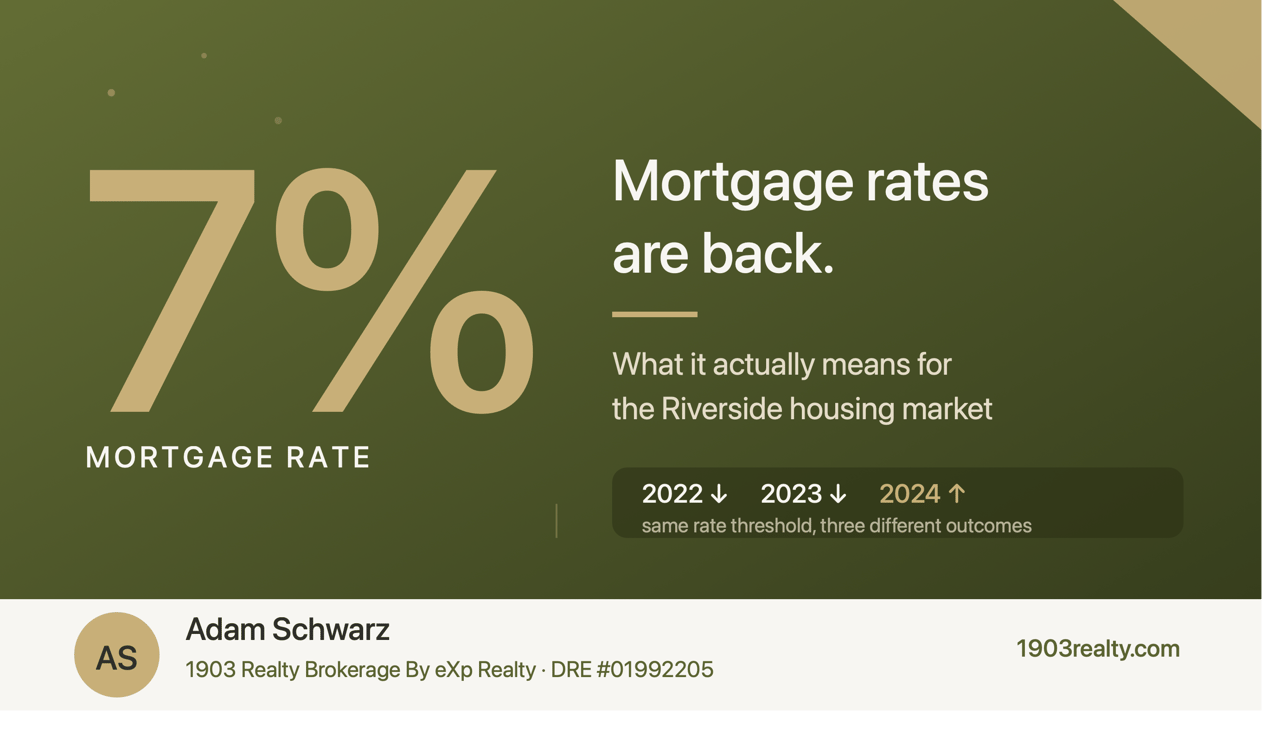
- With 30-year fixed mortgage rates around 6.65% in mid-August 2026, buyers are payment-sensitive, which makes seller concessions aimed at rate buydowns or closing costs a practical differentiator.
- Homes that are well-presented and priced to recent closed sales, not peak-year comps, are still generating strong offers; the market is cooling, not collapsing.
- Sellers who build in an extra 30–60 days compared with prior years, and who price correctly from the start, avoid the most common trap: chasing the market down with reactive price cuts.
What does a cooling Riverside market actually look like right now?
Let me be direct: this is not a crash. But it is a real shift, and sellers who ignore it are the ones who end up with stale listings and frustrated timelines.
Here's what the data shows. According to local MLS-based data for April 2026, Riverside saw 211 homes sold at a median sale price of $630,000 and an average of 71 days on market. The sale-to-list price ratio was 99.7%, meaning buyers are getting homes very close to asking price, but sellers are no longer routinely collecting offers 5–10% over list the way they were in 2021 and 2022.
At the county level, a September 2026 market report on Riverside County found that in August 2026, active listings fell 4.4% year-over-year to 13,125 homes, even as new listings rose 1.5%. The median listing price dipped 1.5% year-over-year to $589,900. Only 18.4% of active listings showed a price reduction, slightly below the national rate of 20.4%, and the median days on market was 63 days.
Meanwhile, portal-level listing data for Riverside puts the median listing price around $739,000 with a median days on market of 49 days as of late August 2026. That's asking-price data, not closed sales, so take it as a directional signal rather than gospel, but it confirms that sellers are still pricing with confidence, even if the pace has slowed.
The statewide picture adds context. California's market cooled slightly in July 2026, with sales pulling back from June's rebound and statewide prices dipping below $900,000 for the first time in four months. The National Association of REALTORS® reported that the Pending Home Sales Index fell 5.4% in June nationally, and existing-home sales declined 2.4% to about 4.09 million SAAR, signs of softening demand that are playing out locally too.
What this adds up to: buyers have more time, more choices, and more willingness to negotiate than they did two years ago. That's the definition of a market where buyers have leverage. If you want a fuller picture of whether this is the right moment for your specific situation, I'd point you to my post on whether it's a good time to sell your home in Riverside CA.
What "buyer leverage" looks like in practice
When I'm working with sellers in Orangecrest or Alessandro Heights right now, here's what I tell them to expect:
- Fewer bidding wars. After the first two weeks on market, it's increasingly common to be working with one offer at a time rather than a stack of them.
- More inspection negotiation. Buyers who feel they have options are far less likely to waive repairs. They'll ask, and in many cases, they'll get.
- Contingencies are back. Financing contingencies, appraisal contingencies, and even sale-of-current-home contingencies, all of which largely disappeared in 2021, are showing up again in Riverside offers.
- Payment sensitivity is high. With 30-year fixed mortgage rates around 6.65% in mid-August 2026 per Freddie Mac, a $10,000 price difference doesn't move the needle much on monthly payment. A seller credit toward a rate buydown, on the other hand, can make a real difference to a buyer's monthly cost, and that's where concessions become a strategic tool rather than a concession.
How do you sell well in this market? Here's what actually works.
I've sold homes in multiple market cycles, and the sellers who come out ahead in a cooling market are not the ones who wait it out hoping conditions improve. They're the ones who get disciplined early and execute well. Here's the playbook.
Price to current closed sales, not peak comps
This is the single most important decision you'll make. Pricing to what your neighbor sold for in early 2022, or even late 2024, will get you a stale listing, not a strong offer. I price my clients' homes using the last 60–90 days of closed sales, and I adjust quickly if the first two weeks of showings don't generate serious interest.
The data supports this approach. The April 2026 sale-to-list ratio in Riverside was 99.7%, which means well-priced homes are selling very close to asking. That's actually a healthy signal, it means buyers aren't lowballing everything. But it also means overpriced homes don't get rescued by multiple offers anymore. For a deeper look at how pricing strategy works in this market, see my post on how to price your home to sell fast in Riverside.
One more thing: if the listing price in your neighborhood has dipped 1.5% year-over-year, as the August 2026 county data shows, waiting another quarter to list in hopes of a higher price is a gamble, not a strategy. Chasing the market down is one of the most expensive mistakes I see sellers make.
Presentation matters more when buyers have options
In a hot market, buyers overlook clutter, deferred maintenance, and bad listing photos because they're afraid to lose the house. In a cooling market, they don't have to. A home that photographs poorly or shows rough in person will sit, and a listing that sits past 30 days starts to raise questions in buyers' minds.
What I tell every seller I work with: the first two weeks of showings are your highest-leverage window. If you don't come out of the gate clean, decluttered, and well-lit in photos, you're starting behind. Minor improvements, fresh paint in key rooms, updated fixtures, a cleaned-up yard, don't require a big budget. They require attention and follow-through before the listing goes live.
Staging, even light staging, consistently shortens time on market. In a city where 63–71 days is the current norm, anything that cuts that number meaningfully has a real dollar value.
Use concessions as a proactive tool, not a last resort
Most sellers think of concessions as something they give up after a buyer demands them. In this market, I recommend flipping that script. Marketing a seller credit for closing costs or a rate buydown contribution up front can differentiate your listing from similarly priced competition, without requiring a headline price cut.
Here's why this matters in Riverside right now. With rates around 6.65%, a buyer's monthly payment on a $630,000 home is significant. A seller credit that funds a temporary or permanent rate buydown can reduce that monthly payment in a way that a $10,000 price reduction simply can't match. That's a real value proposition, and buyers know it.
The key is structuring concessions thoughtfully rather than reactively. That's a conversation I have with every seller before we list, what to offer, how to frame it, and how to avoid leaving money on the table by giving away more than the market requires. If you're also navigating an appraisal gap in this environment, my post on low appraisal options for Riverside sellers covers that specific scenario in detail.
Build flexibility into your timeline and terms
Buyers in a cooling market are more cautious, and that caution shows up in how they structure offers. Being flexible on closing dates, open to rent-back arrangements, or willing to work with a buyer who needs to coordinate the sale of their current home can make your listing more attractive than a competing property at the same price.
From a timing standpoint, plan for roughly two months on market plus 30 days to close once you're under contract. That's a longer runway than 2021–2022, and sellers who don't build it into their plans, for a job transition, a school-year move, or a purchase on the other end, create unnecessary pressure that leads to bad decisions.
Market Indicator | Riverside / Riverside County (2026) | What It Means for Sellers |
|---|---|---|
Median sale price (April 2026, city) | $630,000 | Prices are holding, not collapsing, but peak-year comps will overprice you |
Average days on market (April 2026, city) | 71 days | Plan for roughly two months on market before an offer |
Median days on market (August 2026, county) | 63 days | Consistent with a slower pace; first two weeks of showings are critical |
Median listing price YOY change (August 2026, county) | -1.5% to $589,900 | Modest softness in asking prices; pricing discipline matters |
Share of listings with price reductions (August 2026, county) | 18.4% | Below national rate of 20.4%, well-priced homes are not being cut heavily |
Sale-to-list price ratio (April 2026, city) | 99.7% | Buyers are paying close to asking, if you price right from the start |
30-year fixed mortgage rate (mid-August 2026) | ~6.65% | Payment sensitivity is high; concessions targeting rate buydowns carry real value |
Frequently Asked Questions
How do I know if the Riverside market is really cooling or still a seller's market?
The data points to a cooling market with buyers having more leverage, not a full buyer's market. Homes in Riverside are averaging 63–71 days on market in 2026, longer than the sub-30-day pace of 2021–2022, and county listing prices dipped 1.5% year-over-year in August 2026, according to local market reporting. Prices haven't collapsed, but buyers are negotiating harder on repairs, contingencies, and terms than they were two years ago.
How long is it taking to sell a home in Riverside right now, and how does that affect pricing?
Based on recent data, plan for roughly 63–71 days on market before going under contract, plus about 30 days to close once you have an accepted offer. That's a meaningful shift from the fast-paced market of prior years, and it has a direct impact on pricing strategy: homes that are overpriced don't get rescued by multiple offers anymore, so pricing to current closed-sale data from the last 60–90 days, rather than peak comps, is the most reliable path to a strong outcome.
Should I offer concessions like closing-cost credits or a rate buydown to attract buyers in Riverside?
In the current rate environment, with 30-year fixed rates around 6.65%, concessions aimed at reducing a buyer's monthly payment can be more effective than an equivalent price reduction. A seller credit that funds a rate buydown, for example, has a tangible impact on what a buyer pays each month, which matters more to most buyers than a slightly lower purchase price. Whether to offer concessions proactively or hold them for negotiation depends on your specific property, price point, and competition, that's a conversation worth having before you list.
Is it better to price aggressively from day one or leave room to negotiate in a down market?
Price aggressively from day one. In a cooling market, the first two weeks of showings generate the most qualified buyer traffic, and a home that's priced right from the start consistently outperforms one that starts high and chases down. A 99.7% sale-to-list ratio in Riverside's April 2026 data confirms that well-priced homes are selling very close to asking, meaning you don't need to leave a cushion if you've done the pricing work correctly.
If my Riverside home sits on the market for more than 60–70 days, what should I adjust first?
Start with price, because it's the most powerful lever, but don't adjust it without first ruling out presentation issues. If your photos are weak, the home shows cluttered, or there's a deferred maintenance issue that buyers keep flagging, a price cut alone won't fix the problem. I typically recommend reviewing showing feedback from the first 30 days, addressing any presentation gaps immediately, and then making a meaningful price adjustment if activity doesn't improve, not a series of small cuts that signal desperation without actually moving the needle.
Every situation is different, and the right adjustment depends on your specific property, neighborhood, and competition. That's exactly the kind of analysis I walk my clients through before we make any changes.
The bottom line
Selling in a cooling Riverside market isn't about waiting for conditions to improve or accepting a bad outcome. It's about adjusting your strategy to match the market that actually exists in 2026, and executing that strategy with precision from day one. Sellers who price to current data, present their home well, and get smart about concessions are still closing strong. The ones who don't are the ones who end up with stale listings and reactive price cuts.
If you're thinking about selling in Riverside, whether in Orangecrest, Victoria Woods, Hawarden Hills, Alessandro Heights, or anywhere else in the city, I'm happy to walk you through a current market analysis and a realistic plan for your home. Reach out to schedule a conversation.
Schedule a call with Adam at 1903 Realty to get a personalized market analysis and selling strategy for your Riverside home.
Equal Housing Opportunity. Adam Schwarz, CA DRE #01992205, 1903 Realty Brokerage by eXp Realty, a member of CAR and NAR. This article is general market information only and is not legal, tax, or financial advice. Broker compensation is fully negotiable and not set by law. Confirm your specific numbers, including closing costs, concessions, and net proceeds, with your closing agent, tax advisor, or lender.