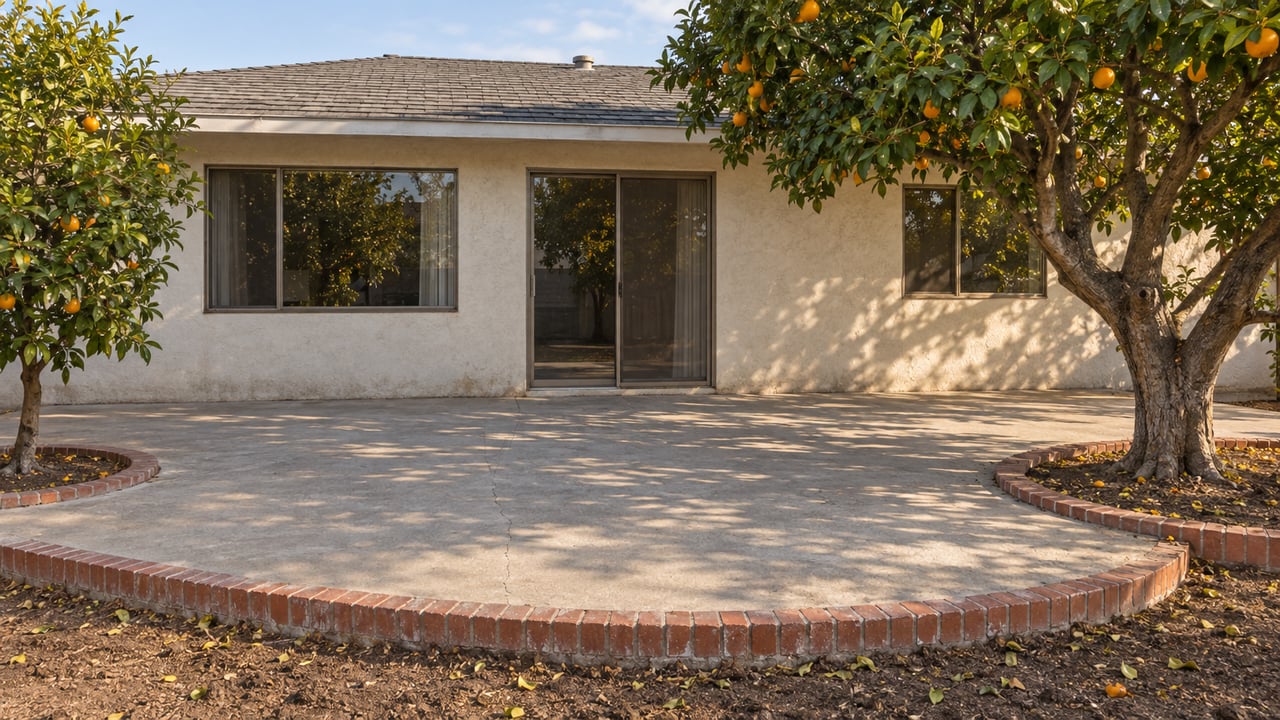
Riverside Public Utilities publishes two water price tables. One is the standard single-family schedule, WA-1A, and the other is WA-12 Agricultural Service. Their per-unit prices are identical. Starting July 1, 2026, both charge $1.52 per hundred cubic feet, or CCF, for the first 8 CCF, $2.23 for the next tier, and $3.57 above that in winter or $4.61 in summer. Both charge $33.36 a month for a standard 5/8- or 3/4-inch meter.
For a grove owner in the Arlington Heights Greenbelt, WA-12 is still cheaper because of how much water it lets you buy at the lowest price, not because of the price itself. Since September 19, 2025, that allocation has been closed to new customers. For anyone weighing a Greenbelt home with citrus trees on it, the rate attached to the meter now matters about as much as the acreage.
The discount is an allocation
On the WA-12 schedule, the City calculates an Agricultural Water Allocation from the crop itself. The formula multiplies local evapotranspiration, measured at the CIMIS station at UC Riverside, by a crop factor and the irrigated area, then adjusts for irrigation efficiency. Citrus gets a crop factor of 0.69, each planted tree counts as 400 square feet of irrigated area, and efficiency is set at 85 percent. Buildings, hardscape, ornamental turf and fallow ground are excluded.
A City staff report from July 2026 explains why that matters. For a property with a residence, WA-12 bills the first 8 CCF at the WA-1A Tier 1 price. The grove's whole allocation comes next, also at the Tier 1 price. Only after that does usage move into the higher tiers. On a standard residential account, the same grove water would land on top of household use and push the bill into the top tier.
| What a grove owner pays per CCF, July 1, 2026 rates | Summer | Winter |
|---|---|---|
| Grove water inside the WA-12 allocation | $1.52 | $1.52 |
| Same water at the WA-1A top tier | $4.61 | $3.57 |
| Gap per 100 CCF | $309 | $205 |
The gap is simple arithmetic from the published tiers, and the published plan says it will widen. RPU's adopted rate plan raised agriculture rates 6.4 percent on July 1, 2026, with another 6.5 percent scheduled for July 1, 2027. In 2027 the WA-12 Tier 1 price rises to $1.62 and the summer top tier to $4.91.
The qualifying bar is specific. A property needs at least half an acre and at least 75 edible fruit or nut trees, or one of the other listed crops. Agriculture has to be a permitted use under the City's zoning, and the owner has to apply and allow an on-site inspection. Because the rate is tied to tree count, it rewards keeping trees in the ground.
A subsidy with a ceiling
The allocation costs RPU money, and California's Proposition 218 restricts how that cost can be covered. Staff reviewed the 197 agricultural customers on the books when the five-year rate plan was built and found the utility was under-collecting the cost of serving them by about $684,000 a year. The City covered that gap with non-rate revenue rather than spreading it to other ratepayers, and set $684,000 as the program's ceiling.
That ceiling stayed under pressure once the rate opened to any qualifying half-acre property. Staff estimated about 12,800 half-acre parcels in the City's sphere of influence. As of May 31, 2026, WA-12 had 245 customers, and an estimated $597,142 of the $684,000 had been allocated. Staff projected that the rate increases taking effect in July 2026 and July 2027 would bring the program within $7,000 of the limit.
Here is how the closure has moved so far:
- September 19, 2025. RPU's General Manager declared WA-12 closed to new customers. The schedule's program-limit section is the provision that calls for closing the rate to new customers, and the staff report cites it in seeking approval of the closure.
- July 13, 2026. The Board of Public Utilities adopted a resolution confirming the closure and recommended City Council approval. The vote was five ayes, one no, one recusal and two absent.
- Late October 2026. The resolution takes effect when City Council approves it. The City Clerk's master calendar, updated October 1, still listed the item as "Anticipated Date Pending Scheduling," and it did not appear on the October 6 or October 20 Council agendas.
The closure doesn't have to be permanent. The schedule says the rate stays closed "until such time as additional non-rate revenues are established," and City Council can raise the program limit by a resolution the Board also approves. In the meantime, RPU's Agricultural Rates and Programs page says plainly that WA-12 "is temporarily closed to new customers."
What the schedule says about a property that changes hands
For a buyer, the main question is whether a grove that already has WA-12 keeps it after escrow closes. The revised WA-12 schedule attached to the July Board item gives a partial answer:
"For Customers applying for service at an existing service address, the Utility will assign a water rate schedule based on the characteristics of the service address. The Utility will presume that any water rate previously assigned to that service address is the appropriate schedule, unless the Customer requests a review for another applicable rate schedule, rate, or optional provision. In certain situations when a Customer does not qualify for a water rate previously assigned to that service address, the Utility will assign the applicable rate to the Customer."
This language ties the rate to the service address, not to the person who signed up for it. It also gives RPU room to reassign the rate if the property no longer qualifies, and any change applies going forward after the next meter reading. The same document says the utility "assumes no responsibility for advising the Customer of lower optional rates." Neither the staff report nor the revised schedule says directly whether a new owner counts as a "new customer" under the closure, and neither sets a sunset date for existing accounts.
So two grove properties with the same acreage and tree count can carry different water costs. The difference comes down to whether one of them was already on WA-12 before September 19, 2025, and whether its trees still meet the 75-tree threshold when a new owner applies for service. Neither detail appears on a listing.
Canal parcels run on different math
Some Greenbelt properties never touch WA-12. RPU points properties with access to the Gage Canal system to WA-8 Greenbelt Irrigation Service instead. RPU's own page describes the Greenbelt as the agricultural and low-density residential area around that canal, which it says was completed in 1890.
WA-8 has a different cost structure. It charges a $9.92 monthly meter fee plus the Gage Canal Company's own per-acre minimum, excess-water and transportation rates, which the RPU schedule doesn't list. The minimum is 156 CCF per acre per month, and it is billed even when no water is delivered or the canal isn't running. The customer also pays for the facilities that bring canal water onto the property, schedules deliveries with the Gage Canal Company, and has to irrigate by sprinkler or another approved non-furrow system. If a property uses both, its WA-12 allocation is reduced by up to 156 CCF per planted acre in the months the canal can deliver.
Why the trees are not easy to swap out
Water would matter less if a buyer could treat the grove as optional. Two other rules make the trees part of what the land is.
The first is zoning. Riverside's General Plan says 1979's Proposition R put the Arlington Heights Greenbelt under RA-5 Residential Agricultural zoning, and 1987's Measure C added policies promoting agriculture and family farms there. City Ordinance 7413 sets a five-acre minimum lot area for RA-5. It allows one single-family home on a smaller lot that existed as of May 15, 1979, provided the home is owner-occupied after construction. The City's SB 9 FAQ lists RA-5 as exempt from the state's lot-split and two-unit law. Because those rules set large minimum lot sizes, the acreage on a Greenbelt parcel tends to stay in one piece, and the trees growing on it are a large part of what that acreage is.
The second is replanting. In an August 2026 column for the Raincross Gazette, UCR emeritus professor Norm Ellstrand reported that CDFA public affairs officer Joshua Bingham confirmed all of Riverside lies inside the huanglongbing quarantine. According to that article, only Louie's Nursery, Cal West Nursery and Y and M Nursery sell certified clean citrus trees to the public in Riverside. Bingham told the Gazette that "lifting a quarantine is biologically unfeasible." Only a handful of local nurseries can supply replacements, so dropping below the 75-tree count that WA-12 requires is hard to undo quickly. The schedule also assigns trees in their first five planted years a lower crop factor of 0.45, which means newly planted trees count for a smaller allocation.
Questions for RPU before a Greenbelt offer firms up
RPU takes agricultural rate questions at 951-826-5285. For a specific property, these questions map directly to the schedule language above:
- Which schedule is the service address on today: WA-1A, WA-8, WA-12, or a combination?
- If it's WA-12, what allocation is on file, and how many qualifying trees was it based on?
- Will a new account holder at that address keep the presumed WA-12 rate while the schedule is closed to new customers?
- If the parcel takes canal water, what are the Gage Canal Company's current minimum and transportation charges per acre?
This post is general information about published rate schedules and zoning, not legal, tax or financial advice. Confirm how any rule applies to a specific property with RPU, the City, and your own professional advisors.
FAQ
Can a Greenbelt property sign up for WA-12 right now? RPU's page says the schedule is temporarily closed to new customers. The General Manager closed it as of September 19, 2025, and as of late October 2026 the Board's confirming resolution was still waiting for a Council date.
Does WA-12 charge less per unit than regular residential water? No. In 2026 the per-CCF prices match WA-1A. The savings come from the crop-based allocation that gets billed at the Tier 1 price.
Could the rate reopen? The schedule lets City Council raise the $684,000 program limit if new non-rate revenue is identified, with Board approval.
If you own a Greenbelt grove and are thinking about selling, knowing which water rate your meter carries is part of pricing the property correctly. 1903 Realty can help you document the rate, the tree count and the canal access before a buyer asks about them, and turn that into a realistic number. Start with a Get Home Value request and we'll build the estimate around how your property is actually watered.