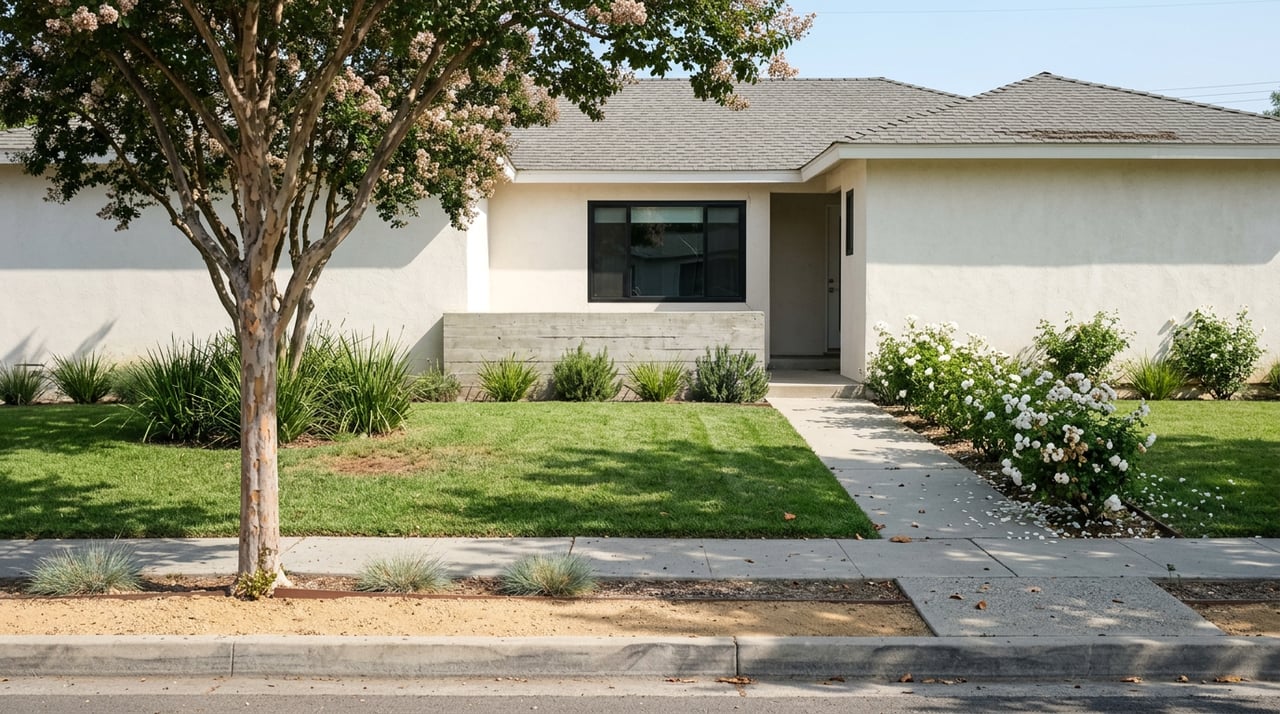
Start at the corner of Victoria and Jane, where a nonprofit called Victoria Avenue Forever has planted a bed of Lantana 'Radiation' and Mexican bush sage around the historical marker that names this stretch Riverside's Cultural Heritage Landmark #8. Stand there for a minute and it feels like the whole avenue: palms, a wide grass median, orange trees somewhere in the middle distance. Walk four blocks in either direction and that impression falls apart. The trees change. The shade pattern changes. Even the traffic sound changes.
That's the thing about Victoria Avenue that the drive-by version never tells you. It isn't one continuous scenic street. It's a chain of quarter-mile rooms, each planted on purpose to look different from the one before it, and knowing which room you're walking into is the difference between a pleasant stroll and a genuinely good one.
The Quarter-Mile Rule
Franz Hosp, Riverside's pioneer landscape designer, laid out Victoria Avenue's median in the spring of 1892 with a specific rule in mind: each quarter-mile block gets planted to one, occasionally two, species of small flowering tree or large shrub, and the pattern repeats down the corridor rather than blending into a single planting scheme. According to Pacific Horticulture's history of the avenue, the rotation includes:
| Block planting | Character |
|---|---|
| Saucer magnolia | Bare branches burst into large pink-and-white blooms before the leaves come in |
| Redbud | Small, dense clusters of magenta flowers directly on bare wood |
| Crape myrtle | Papery summer blooms that hold color through the hottest months |
| Chaste tree | Spiky lavender-blue flower stalks, popular with bees |
| Pyracantha | White spring flowers give way to bright orange-red berries later in the year |
| Red horsechestnut | Upright red flower spikes above dense foliage |
| Callery pear | Clean white spring bloom, glossy leaves the rest of the year |
| Flowering peach and nectarine | Some of the earliest color on the avenue, often before anything else moves |
The median palms are Mexican fan palms, while the outer parkway alternates California fan palms with Italian cypress, a deliberate contrast between the two planting zones that most walkers never separate out. That's the mechanism behind the déjà vu feeling of never quite remembering which block had which tree. You're not misremembering. The avenue was built to keep changing on you every quarter mile.
Where the Marked Path Ends and the Street Takes Over
Victoria Avenue itself runs 7.6 miles from La Sierra Avenue north to Arroyo Drive, and running-route trackers rate it as the most scenic on-road stretch in the Riverside area, with a caveat worth knowing before you lace up: it's still a live road with traffic in both directions, not a closed park path. The separated, paved bike path that parallels the street only covers part of that distance, running about six miles from La Sierra and Victoria up to Arlington and Victoria, according to TrailLink's trail listing. Past Arlington, the final stretch toward Arroyo Drive and the Victoria Bridge has no dedicated path alongside it. You're walking or riding the shoulder of the parkway itself for that last leg.
There's also a known gap in the paved path between Harrison Street and Tyler Street, where cyclists have to merge briefly into the roadway before picking the trail back up. If you're riding with kids or on a bike without great low-speed handling, that's worth planning around rather than discovering mid-ride.
Three elementary and middle schools sit close enough to the path to double as informal parking and access points: Gage Middle School on Lincoln Avenue, Washington Elementary on Jane Street, and Harrison Elementary on Harrison Street. On school mornings, expect more foot and bike traffic near those three spots than anywhere else on the route.
A Development That's About to Extend the Trail
The La Sierra end of the avenue is where the next real change is coming, and it's not cosmetic. In October 2025, the Riverside City Council voted 6-1 to approve a 49-home development from Warmington Residential on 9.91 acres of existing orange groves at the corner of Victoria and La Sierra avenues, according to reporting from the Raincross Gazette. The homes will range from 3,690 to 7,437 square feet, and the project used state density bonus law to include three affordable units for very low income households.
The part that matters for anyone who already walks or bikes this stretch: as a condition of approval, the developer agreed to preserve 100 feet of orange grove frontage along Victoria Avenue and construct a new 10-foot multipurpose trail on the site, along with traffic calming measures the city and developer are still working out. The vote followed genuine community pushback over housing density and grove preservation in a historic corridor, and it wasn't unanimous. Whatever side of that debate a resident lands on, the practical result for trail users is a widened, more contiguous path exactly at the end of the avenue where the current paved route already begins.
Who Actually Keeps the Trees Alive
The block-by-block plan only survives because someone maintains it, and that someone isn't just the city. In 1990, large red dots started appearing on some of the avenue's hundred-year-old eucalyptus trees, marking them for removal. A group of residents worried the trees wouldn't be replanted and formed Victoria Avenue Forever, a nonprofit that organized its first tree-planting event along the median in June 1991. In its first decade, the group planted roughly 800 trees along the avenue, most of them donated in memory of a specific person or occasion.
That detail changes how you read the plantings if you know it. The particular magnolia at one corner or the redbud at another isn't generic municipal landscaping. There's a meaningful chance it was planted by a family, for a reason, sometime in the last three decades. Victoria Avenue was declared Riverside's Cultural Heritage Landmark #8 in June 1969 and added to the National Register of Historic Places in October 2000, but the Victoria Avenue Forever volunteers are the reason the landmark designation still means something on the ground rather than just on paper.
Refueling Along the Route
The garden at Victoria and Jane isn't the only thing on this stretch that's been here longer than most of Riverside realizes.
A half mile or so off the avenue near the Tequesquite Arroyo sits the Victoria Club, a private members' club incorporated on October 16, 1903, making it one of the oldest clubs in Southern California. It runs an 18-hole golf course, tennis courts, a pool, and a Victorian-style clubhouse, though access is membership-based rather than a walk-in stop.
For public courts, Andulka Park has ten tennis courts including a stadium court and a clay court, with lessons available through its pro shop, a rare enough amenity that serious players make a point of driving in from other parts of the city.
Closer to the Magnolia Center side of the neighborhood, Backstreet Restaurant has been serving pastrami and corned beef sandwiches since 1968, with outdoor seating and cream pies that regulars mention as often as the sandwiches. Magnolia Town Center, anchored by a Ralphs grocery store, covers the practical end of things if you're refueling with a coffee or a quick lunch rather than a sit-down meal after a longer walk.
The Avenue Rewards Knowing Which Block You're On
None of this shows up if you only ever drive the length of Victoria Avenue on the way somewhere else. The quarter-mile planting scheme, the point where the paved path disappears, the memorial trees planted by neighbors rather than contractors, the trail extension coming at the La Sierra end. All of it depends on walking the same stretch enough times to notice what changes block by block. That's the actual case for treating this as a routine rather than a one-time scenic drive: the avenue gives you something different depending on which quarter mile you're standing in, and that only becomes obvious with repetition.
It's worth mentioning, purely as a coincidence of dates, that the Victoria Club up the road was chartered in 1903, the same numbers behind 1903 Realty. We didn't plan that. But if you're the kind of person who notices the tree species changing block to block, you're probably also the kind of person who'd appreciate a coincidence like that. If you ever want to talk about what's happening with homes in this part of Riverside, or just want a second opinion from someone who tracks this neighborhood closely, reach out to Adam Schwarz any time.