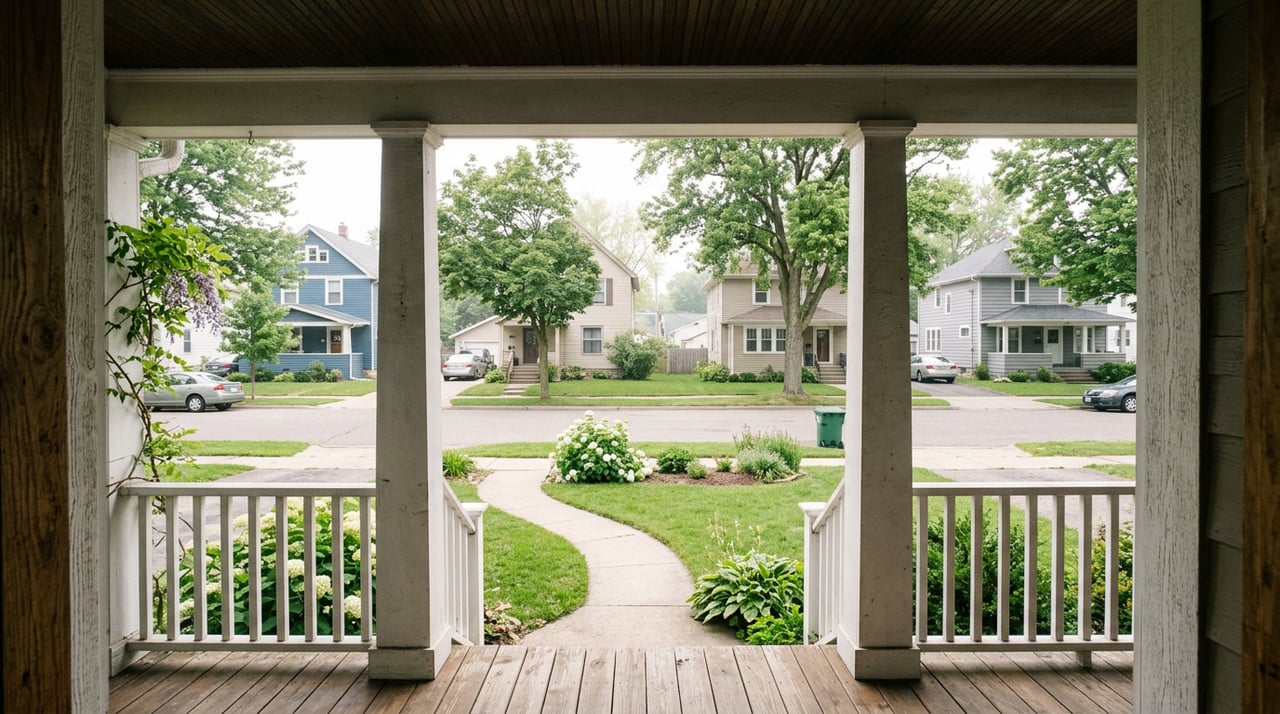
Scroll through active listings in Wood Streets long enough and you'll notice two kinds of language doing very different jobs. One listing leads with "AWARDED the Mills Act Contract," treating the tax break like a bonus room. Two blocks over, another 1920s bungalow with the same square footage, the same bay windows, the same tree-lined street simply says "highly desirable Wood Streets neighborhood" and stops there. A buyer comparing the two assumes the second house probably qualifies for the same savings, since it's the same era, the same charm, the same zip code. That assumption is wrong often enough that it's worth correcting before you write an offer, not after.
The reason comes down to a distinction buyers should check: the city doesn't grant Mills Act eligibility to a neighborhood. It grants it to a parcel, based on which of four legal categories under Title 20 of the Riverside Municipal Code that specific parcel carries. Wood Streets contains all four kinds, sometimes on the same block, and the category attached to your house, not the neighborhood name on the listing, decides whether property tax relief is even on the table.
Four Boxes, One Neighborhood
Riverside's Cultural Resources Ordinance recognizes City Landmarks, Structures of Merit, Historic District contributors, and Neighborhood Conservation Area (NCA) contributors. All four can qualify a property owner for a Mills Act contract, but they carry different thresholds and different levels of design review.
| Designation | What it takes to qualify | Mills Act eligible |
|---|---|---|
| City Landmark | Highest order of historic or architectural significance | Yes |
| Structure of Merit | Meaningful but lesser significance than a Landmark | Yes |
| Historic District contributor | Property sits within a geographically defined district with a concentration of historic resources | Yes |
| Neighborhood Conservation Area (NCA) contributor | Similar concept to a Historic District, applied to areas with fewer historic resources overall | Yes |
The Rosewood Place stretch of Wood Streets is a working example of how granular this gets. A 1927 cottage there is a reminder that the neighborhood label alone doesn't establish whether a parcel has a designation.
Neighborhood Conservation Area: A Designation to Check
Of the four categories, NCA is the one buyers hear about least and the one most likely to shift under them. It's a lighter-weight designation than a full Historic District, created for areas that have real character but a lower concentration of individually significant structures. In Wood Streets, that makes NCA status the quiet workhorse behind a lot of Mills Act contracts on modest bungalows.
It's also the piece of Title 20 that's been under active review. In May 2023, Riverside's Cultural Heritage Board held a workshop on proposed amendments to Title 20 that could have reshaped historic status for portions of Wood Streets, along with parts of Old Magnolia, Eastside, Rockledge, and Arlington, according to reporting from the Raincross Gazette. The concern wasn't abstract: NCA designations are what let those homeowners apply for Mills Act relief in the first place, so any change to how NCA boundaries get drawn or maintained touches real dollars.
Separately, reporting from the Old Riverside Foundation describes a broader package of Title 20 changes, described as having been in the works for a couple of years, heading toward a final vote at City Council. One piece of that package would change how landmark nominations work, allowing a third party rather than only the owner to propose a property for designation. The Foundation backed the changes as a strengthening of preservation practice, not a taking of rights. What matters for a Wood Streets transaction is simpler: the rules governing which properties carry which designation have gone through real revision in recent years, which means the NCA status you find today deserves a direct check rather than an assumption carried over from an old listing sheet or a neighbor's recollection.
The City of Riverside says a Mills Act contract doesn't expire when a house changes hands. It runs with the land on a rolling ten-year term, straight through closing, to whoever holds title next.
What a Mills Act Contract Actually Buys, and When
If a Wood Streets property does carry a recorded Mills Act contract, here's what that means in practice. The contract is a minimum ten-year agreement between the owner and the city that reduces property tax in exchange for documented reinvestment in the property's upkeep. It automatically renews each year, creating what the city calls a rolling term, and because it's recorded against the property rather than tied to a person, it transfers to a new owner at sale without any action required at closing.
For a buyer weighing whether to apply for a new contract rather than inherit an existing one, the mechanics are worth knowing before you get attached to the idea. The City of Riverside accepts applications only between January 1 and May 31 each year. Citywide, Riverside allocates roughly fifteen to twenty Mills Act contracts annually, split on average between about thirteen residential and two commercial awards. If applications exceed that cap, the city selects among them at random rather than first-come, first-served. There's a non-refundable $126 application fee and a $957 contract initiation fee, the latter due as a post-dated check. Contracts typically get signed in August, go to City Council for approval in October, and are recorded with the county by year's end.
The part that catches new owners off guard is the timing of the actual savings. The City of Riverside Mills Act information packet says a contract approved in 2025 doesn't produce a smaller tax bill right away: owners who signed in 2025 saw their first savings show up on the fall 2026 tax coupon, a lag of roughly a year and a half between approval and the first dollar back. Anyone budgeting a purchase around future Mills Act savings should plan for that gap rather than a same-year discount. There's also an annual reinvestment requirement tied to the city's July-to-June fiscal year, and owners can't bank ten years of savings toward one large project. The city inspects the property before approving a contract and at least every five years afterward to confirm compliance, so post-close renovation plans need to account for that oversight, not just the historic district design guidelines.
What to Verify Before You Write the Offer
- Ask for the specific Title 20 category on the parcel, not the neighborhood-level label. "Historic Wood Streets" in a listing description tells you almost nothing about eligibility on its own.
- If a Mills Act contract already exists, request the recorded contract number and confirm its current status. It transfers with the deed, so you're stepping into the same rolling ten-year term.
- If no contract exists and you want one, budget for the $126 and $957 fees and remember the January 1 to May 31 application window. The citywide cap means a well-qualified property can still miss out in a given cycle.
- Ask whether the parcel sits inside one of the areas named in the 2023 Cultural Heritage Board workshop. Boundaries touching NCA status in Wood Streets, Old Magnolia, Eastside, Rockledge, and Arlington were the subject of real ordinance discussion in recent years, so confirm current status directly rather than relying on an older listing description.
- Factor the annual reinvestment requirement and periodic city inspection into any renovation budget, especially if you're planning work in the first few years of ownership.
The due diligence conversation in Wood Streets tends to focus on foundations, old wiring, and roof age, and those matter. But the box a parcel checks under Title 20 is worth real annual dollars and, in parts of this neighborhood, that box has been the subject of real ordinance-level revision in recent years. Confirming it before you close costs nothing. Assuming it based on the word "historic" in a listing description can cost you a tax benefit you thought you were buying.
If you're comparing offers on a Wood Streets bungalow or trying to figure out what your own home's designation is actually worth at resale, that's exactly the kind of parcel-level detail 1903 Realty's Adam Schwarz runs down before you go into escrow, not after. Get Home Value and let's talk through what your specific address carries under Title 20.
This article is general information, not legal, tax or financial advice. Consult a qualified professional about your situation.